GSTR-1
By invoice and by rate, with the HSN summary. Opening bills are left out.
LoomLedger
Sale bills and purchase bills, challans with and without rates, cheques that are not money until they clear, yarn and grey-cloth stock, job work with ITC-04, GSTR-1, 3B and 9, a trial balance that is forced to tie. Everything a Surat mill files, and the things it never had a place for.
Generic accounting software knows about invoices and ledgers. It does not know that a challan goes out with no rate because the price is settled at billing, that a cheque received is not money in the bank, that 100 kg of yarn comes back from sizing as 96 kg of beam and 4 kg of waste, or that a job worker’s beams are not your stock. LoomLedger does, and it refuses to pretend otherwise.
A tax invoice, the way the statute wants it
Place of supply decides whether the tax splits into CGST and SGST or goes as IGST. Rounding happens per line and once more on the total, in the order the rule says, so the half-tax on ₹1,000.10 at 5% never comes out a paise over. The amount in words is in lakh and crore, because that is how the figure is read out. Change the state, change a rate, add a line.
| Item | HSN | Qty (m) | Rate / m | GST % | ₹ |
|---|
In words:
A cheque is not money in the bank
A cheque clears on a date nobody controls. Between the day it changes hands and the day it clears, the money is neither with the customer nor in the bank. Most software posts it to the bank on day one, and the bank ledger is then wrong by the float at every reconciliation — so nobody reconciles. LoomLedger posts a receipt to “cheques in hand”; clearing is a second entry; a bounce mirrors the original line by line and re-opens the invoice. Walk a cheque through its life.
| Account | Dr | Cr |
|---|
Together with LoomWatch
LoomLedger knows the yarn issued to each beam. LoomWatch knows the picks woven and the pick density, so it knows the yarn that went into cloth. Set the month’s figures and the yarn rate. The difference is what a count in the godown would find — if anybody counted.
Statutory
By invoice and by rate, with the HSN summary. Opening bills are left out.
With a cross-check against the GST ledgers, so a journal posted straight to a tax account shows up before the notice does.
Twelve 3Bs added up and reconciled against the audited books — the week of work, laid out.
Paste the portal’s download. Matched on GSTIN and invoice number, never on amount — the amount mismatch is the finding. Unclaimed credit is listed by name.
Job-work challans out and back, with the 180-day clock, only for the legs where you are the principal.
What you deducted (26Q, by section) and what was deducted from you, kept apart because they are different returns. TCS under 206C(1H), credited as a liability, never as sales.
Tax invoices carry the fields the portal asks for; the GST invoice has its own renderer because it is a statutory form, not a table.
Every posting, who made it, when, and what it replaced. A posted voucher is immutable; a correction is a new entry.
The mill’s own objects
Prepared with ends, count and sizing cost; mounted on a loom; the cloth woven off them and the sizing loss against the construction.
Warp and weft, split, to a beam or a loom, with a consumption standard per quality — and a variance verdict only where you set a tolerance.
A roll entry is a cloth inspection: grade, defects, the folder’s words, the loom. The label carries a Code 128 barcode drawn by the software itself.
How many metres of A-grade poplin are on the shelf — the question a mill answers before promising a delivery.
Cost per design from what it consumed, against what it sold for. Blank, not −100%, when a design was woven this month and sold next.
Which loom serves which order line between which dates, and whether Tuesday is going to happen — at the last 14 days’ rate, not the lifetime average.
The store-keeper types the count, not the difference. A line that agrees writes nothing and is not an error; a shortage goes to its own account, never hidden inside consumption.
An order is a promise and moves no stock. Receipts match the order line, not the item. A quotation expires on its own date and keeps itself when accepted.
Bill entry
Enter moves to the next field, including an empty one. A supplier who does not exist yet is offered as the last row of the dropdown; a small dialog asks only what the bill cannot wait for, and the new party is selected when it closes. A yarn bill for a new supplier no longer means abandoning the bill, finding the supplier screen and coming back.
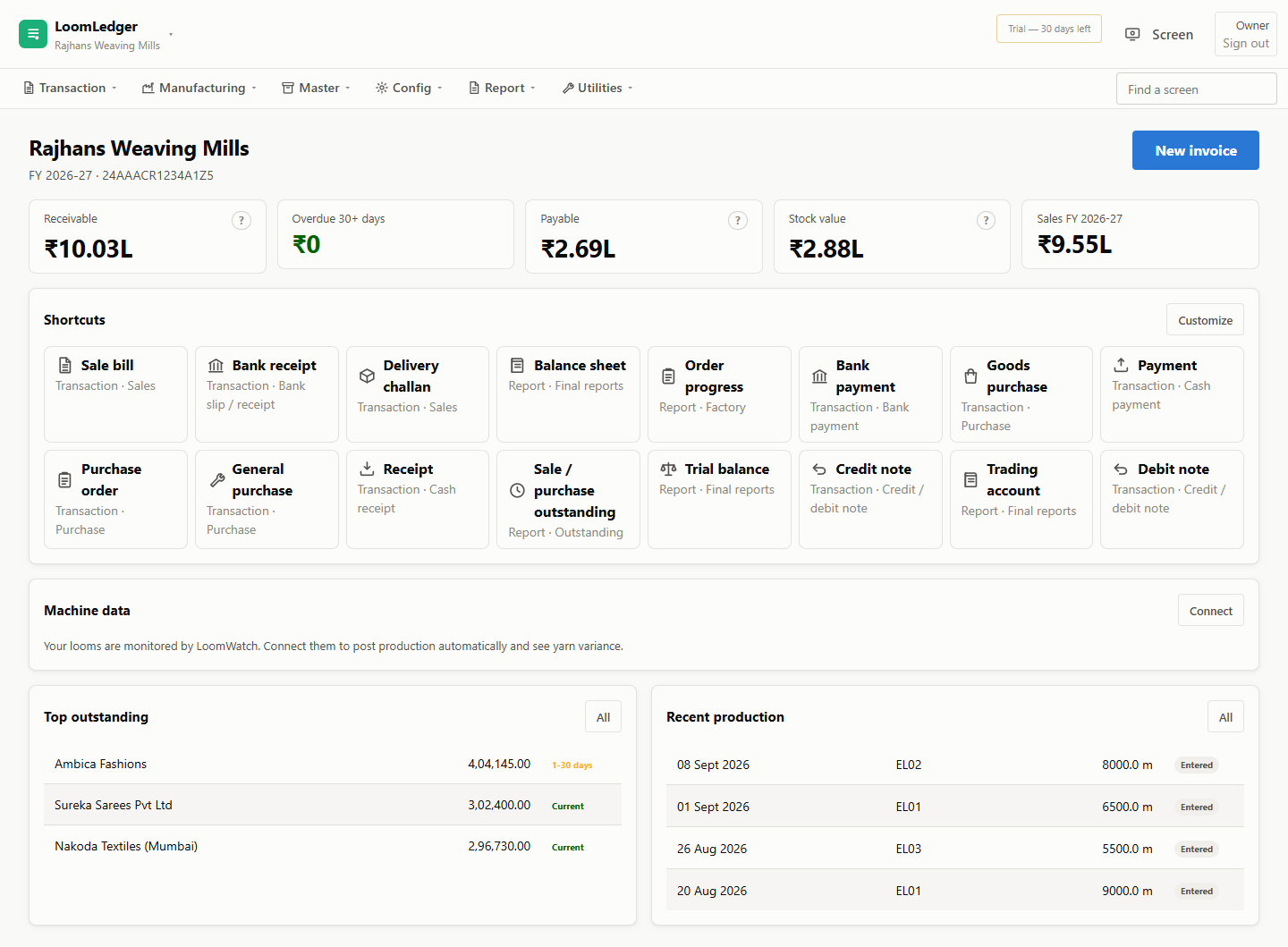
Everything in LoomLedger
This is the software’s own menu, not a wish list. Every entry opens a screen that exists today.
LoomLedger stands alone for a mill with no monitoring — production is typed, and lands as the same row. With LoomWatch, it arrives by itself.