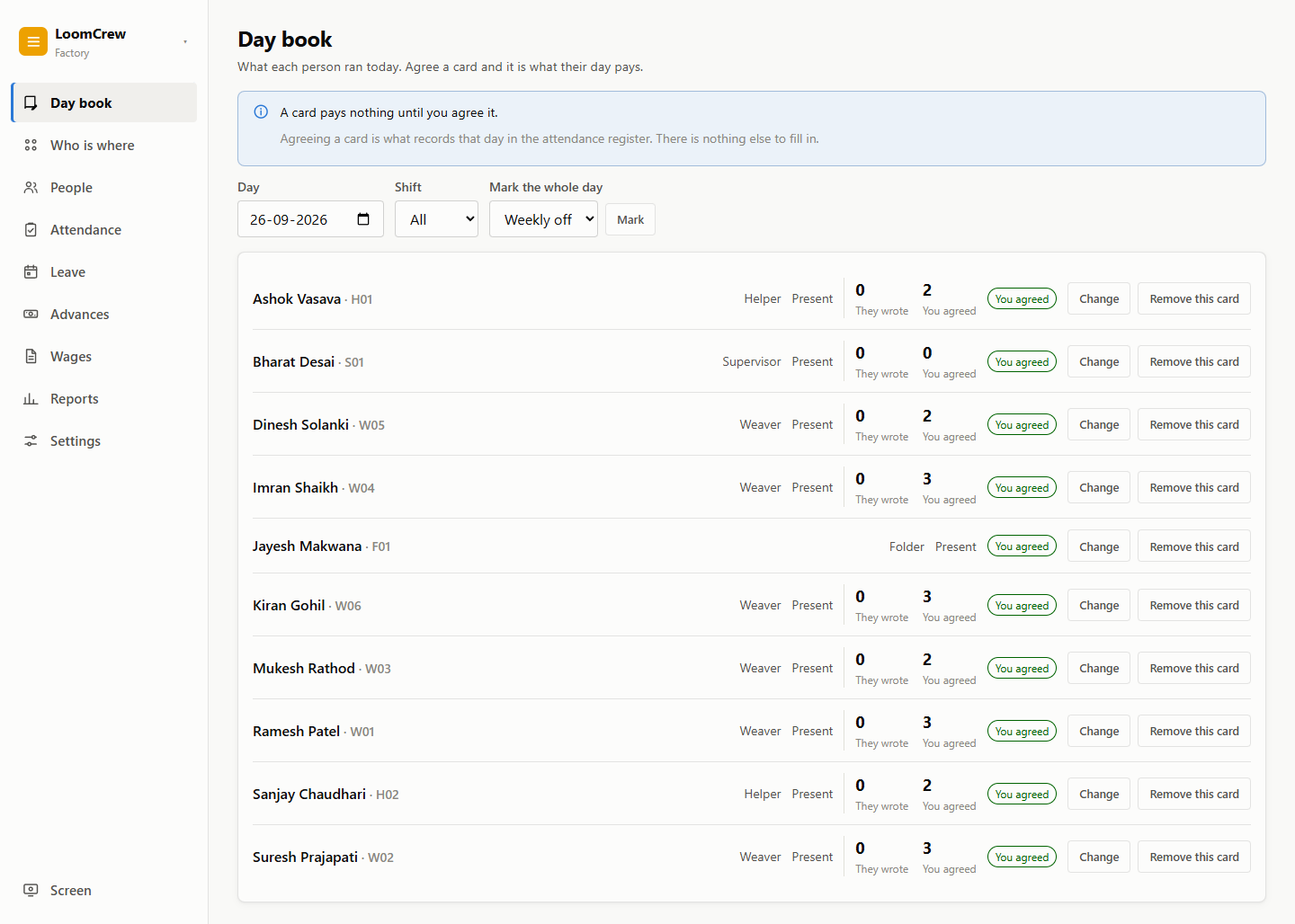
The day book is the only place a day is recorded
Agreeing a card is what marks the person present. There is no second tick-sheet to forget, and the two can never disagree.
LoomCrew
A weaver runs four machines on Monday and seven on Tuesday, and the day’s pay follows that count. The record was a paper book per worker, brought to the owner at the end of the shift. LoomCrew is that book as rows — and the owner’s nod is what turns a claim into a wage.
Payroll software assumes a person has a job and a rate. A Surat shed does not work like that. The same man is a weaver on Monday and a helper on Thursday, runs a different set of machines every day, is paid by a slab that goes 480 for four machines and 620 for five, and sometimes folds thans for a piece rate on the side. The paper book handled all of it. So does this.
The day card
Tick the machines the weaver says they ran. Then, as the owner, strike one off and agree the card. Two marks per machine — claimed and confirmed — so a struck-off machine stays visible as a disagreement the worker can point at. Until the card is agreed, the wage is a dash: a worker whose book the owner has not looked at must never reach a payroll as having earned nothing.
Not agreed — pays a dash, not a zero.
Slab pay
Plenty of mills agree the figure per machine count and the steps are not linear. So the slab is a table: four is 480, five is 620, six is 700. Seven machines with no seventh step is a blank, never “the nearest lower step” — because 700 for a seven-machine day looks like an answer, and it is the wrong one.
| Machines | Pays |
|---|---|
| 3 | ₹380 |
| 4 | ₹480 |
| 5 | ₹620 |
| 6 | ₹700 |
The wage sheet
Cloth the looms measured, over the shifts LoomCrew says a person worked, at the rate LoomCrew holds. A weaver on piece rate is paid for metres the looms counted; a folder is paid for the thans they counted by hand; somebody who does both is paid for both, added as money, which is the only way two units can meet. A day waiting for the owner shows how many days are the reason the total is blank.
| Person | Role | Days | Machine days | Cloth (m) | Hand count | Waiting | Wage |
|---|---|---|---|---|---|---|---|
| Ramesh | Weaver | 26 | 142 | — | — | 0 | ₹14,620 |
| Suresh | Weaver | 25 | 131 | — | — | 2 | — |
| Kiran | Weaver (piece) | 26 | — | 11,840 | — | 0 | ₹16,576 |
| Mahesh | Folder | 24 | — | — | 612 than | 0 | ₹9,180 |
| Dinesh | Helper | 26 | 98 | — | — | 0 | ₹8,320 |
| Total | — | ||||||
One register
Agreeing a card is what marks the person present. There is no second tick-sheet to forget, and the two can never disagree.
Written on the confirming side only, because overtime is something a mill grants.
The roster reads the agreed cards, so it names who actually ran the loom — not whoever was rostered last month.
A helper on a weaver’s machine is a real day. Two weavers claiming one machine is flagged, and both are named, because it is the only way a worker can be paid for work they did not do.
The card’s job decides the rate. A person holds the jobs they can do, and a card for a job they do not hold is refused by name.
The folder, the cutting man, the winder and the sizer are on the day book with a job and no machines — and that card is how they reach the wage sheet at all.
The worker’s own screen
A worker signs in with a PIN that never leaves the server and sees one screen: today’s card, the machines on it, their own past days, and — if the mill allows it — their own wage. No navigation, no monitoring, no reports; there is no screen a curious worker can reach, because the shell those screens live in is never loaded. Large type, thumb-sized targets, Hindi by default. Kiosk mode for a shared tablet at the gate is off unless the mill turns it on.
Everything in LoomCrew
LoomCrew stands alone for a mill with no monitoring. With LoomWatch, the piece-rate wage reads the metres the looms measured — and with LoomLedger, the month’s staff cost posts to the books in one press.